The 15 Jobs AI Is Changing Fastest in 2027
Five jobs most likely to be replaced, five that appear remarkably resistant—and five that AI has already largely erased.

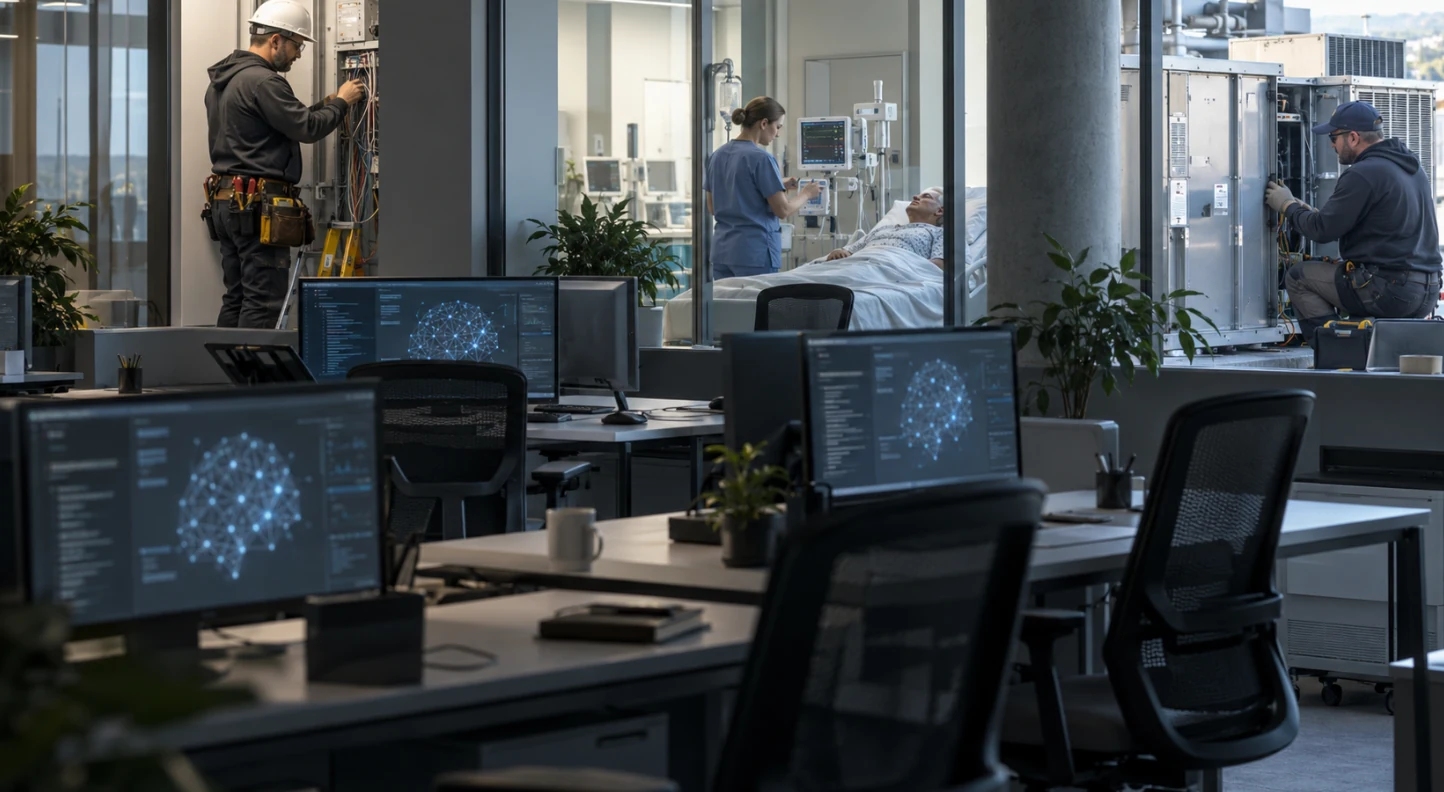
The easiest way to understand which jobs artificial intelligence can replace may be to stop thinking about intelligence.
Think instead about hands.
A customer-service agent spends most of the day talking, listening, reading and entering information into a computer. An electrician may spend the morning tracing a fault through wiring installed forty years ago by someone who apparently had strong opinions about building codes. Both jobs require knowledge. Only one requires a person to physically enter an unpredictable environment and make reality cooperate.
That difference is becoming increasingly important.
After years of predictions that artificial intelligence would either eliminate work on an enormous scale or create enough new professions to make the concern irrelevant, the first useful evidence is beginning to arrive. The pattern is less dramatic than either prediction and, for some workers, considerably more consequential.
AI has proven exceptionally good at replacing tasks that happen entirely inside computers. It has been much less successful when the work involves manipulating the physical world, dealing with unusual circumstances or accepting responsibility when the obvious answer turns out to be wrong.
That does not mean any occupation is permanently safe. Nor does it mean the exposed professions will disappear completely. A job can survive even while the number of people employed to do it falls sharply.
With that in mind, here are five occupations that appear particularly exposed, five that have resisted automation surprisingly well, and five where the displacement is no longer theoretical.
Five jobs most likely to be replaced next
1. Customer-Service Representatives
The traditional call center is built around a task AI understands unusually well: a person asks a question, the company possesses information relevant to the answer, and someone must connect the two.
For decades, the difficult part was conversation. Early automated systems could follow menus but struggled the moment a customer interrupted, changed subjects or described a problem in a way the programmer had not anticipated.
That barrier is disappearing.
Current voice systems can hold extended conversations while simultaneously reading account histories, policies and product documentation. They can authenticate customers, process routine transactions and decide when a problem falls outside their authority.
Human agents remain considerably better at unusual disputes, distressed customers and situations where company policy does not fit reality. Increasingly, however, those agents are receiving only the calls the machine could not resolve.
The occupation may survive. The enormous rooms filled with people handling every call probably will not.
2. Entry-Level Bookkeepers
Bookkeeping has been automating itself for years, one small task at a time.
Receipts became digital. Bank feeds replaced manual transaction entry. Invoices became searchable. Payroll moved online.
AI connects those pieces.
A modern accounting system can read an invoice, identify the vendor, categorize the expense, match the payment, reconcile the transaction and flag anything unusual for review. The interesting part is not that a computer can perform any one of those tasks. It is that increasingly it can perform the entire sequence.
Accountants are not disappearing. Complicated tax questions, business decisions, unusual transactions and financial judgment remain deeply human problems.
Typing numbers from one piece of software into another is becoming harder to justify as a profession.
3. Junior Copywriters
Artificial intelligence does not need to become Shakespeare to threaten commercial writing.
It needs to write an acceptable description of a refrigerator.
Much of the writing produced by businesses is not intended to be memorable. It consists of product descriptions, email campaigns, advertising variations, social posts, internal announcements and search-oriented articles.
Those were once useful entry points for young writers.
They are also precisely the kind of assignments current AI systems can produce quickly and in enormous quantities. A marketing manager who once distributed briefs among several junior employees can now generate twenty variations before lunch and ask a human to choose among them.
Original reporting, distinctive creative work and brand strategy remain harder problems.
Competent sentences have become very cheap.
4. Loan and Insurance Processors
A stack of paperwork is an inconvenience to a person.
To a computer, it is data waiting to become structured.
Loan and insurance processing relies heavily on gathering documents, checking that required information is present, comparing it against defined criteria and sending unusual cases to someone with greater authority.
Modern AI systems are increasingly able to perform the gathering and checking themselves.
That does not necessarily remove the underwriter, claims specialist or loan officer who makes difficult decisions. It removes much of the work that traditionally happened before the file reached that person.
Automation often arrives this way: not by eliminating the person at the top of a process, but by shortening the line beneath them.
5. Entry-Level Software Developers
This is the strangest occupation on the list because demand for software continues to grow.
So does the amount of code a single experienced developer can produce.
Coding assistants can now generate routine functions, create tests, identify errors, translate between programming languages and construct substantial portions of straightforward applications. None of that eliminates the need to understand what the software is supposed to do.
It does change who needs to type every line of it.
The vulnerable position is therefore not necessarily “software engineer.” It may be the traditional junior developer whose early career consisted largely of implementing clearly defined pieces of a system designed by someone more experienced.
AI is learning those assignments quickly.
Five jobs least likely to be replaced
The jobs that have resisted AI are not necessarily those requiring the most education.
Many simply require someone to be there.
1. Electricians
An AI system can explain how a circuit should be wired.
The building has other ideas.
Real electrical work involves old construction, undocumented modifications, damaged components, inaccessible spaces and the occasional discovery that whoever worked on the system previously considered the diagram more of a suggestion.
AI is already becoming useful for diagnosis, planning and code reference. Those tools may make electricians faster.
They do not climb ladders.
Growing use of batteries, solar installations, vehicle charging and increasingly complex electrical systems may actually make the profession more valuable as its tools improve.
2. Plumbers
Plumbing has the same inconvenient characteristic.
The problem is usually somewhere physical.
A machine can recognize the symptoms of a blocked line, recommend a repair and identify the correct replacement part. It still needs someone to open the wall, discover that the pipe is corroded, realize the fitting will not move and decide what to do next without flooding the building.
Robotics could eventually change that equation.
For now, human flexibility remains considerably cheaper than building a machine capable of handling every crawlspace, stripped fitting and badly remodeled bathroom in the country.
3. Nurses
Healthcare is one of the areas where AI capability and AI replacement are easiest to confuse.
Systems can already summarize records, monitor measurements, identify patterns and assist with diagnosis. Those capabilities are substantial.
Nursing involves all of those things and then a patient tries to get out of bed.
Bodies are not standardized datasets. Patients become frightened, confused, uncooperative or suddenly worse. Someone administers medication, changes dressings, notices the patient's color looks wrong and decides that a number on a screen does not match the person in front of them.
AI may become one of the most powerful tools nurses have ever received.
That is not the same thing as becoming the nurse.
4. HVAC Technicians
Heating and cooling equipment has become increasingly computerized, which might seem to make technicians easier to replace.
In practice, the opposite may be happening.
HVAC work sits at the intersection of electrical systems, mechanical equipment, airflow, refrigerants, sensors and software. A diagnostic system may identify the likely failure remarkably quickly.
Someone still has to confirm it, reach it and repair it.
The smarter the equipment becomes, the more useful AI may be to the technician carrying the tools. The technician remains necessary because eventually the problem leaves the screen.
5. Construction Supervisors
A construction plan is orderly.
A construction site rarely is.
Materials arrive late. Weather changes. A subcontractor discovers something that does not match the drawings. An inspector objects. Two trades need the same space at the same time.
Scheduling software can optimize an ideal project with astonishing precision. Supervisors spend much of their time dealing with the moment when the ideal project encounters the actual one.
That work combines technical knowledge, negotiation, judgment and physical presence.
Machines are excellent at plans.
Construction supervisors specialize in what happens to them.
Five jobs AI has already largely replaced in 2027
There has been no single announcement marking the first occupation lost to generative AI.
Instead, some jobs have simply become harder to find.
The work still exists. In many cases, the worker does not.
1. Transcriptionists
Transcription may be the clearest example.
Meetings, interviews and recorded conversations can now be converted into searchable text almost immediately, with individual speakers identified and important sections summarized automatically.
Humans remain involved where certification, confidentiality or unusually poor recordings require review.
Routine transcription once required hours of human attention for every hour recorded.
That relationship has largely disappeared.
2. Tier-One Technical Support Agents
The lowest level of technical support was designed around a script.
AI turned out to be very good at reading one.
Modern support systems can identify hardware and software versions, inspect permitted diagnostic information, walk users through standard repairs and escalate the conversation when those procedures fail.
Experienced support technicians remain valuable precisely because unusual problems do not follow scripts.
The job consisting mostly of asking customers to follow them has become increasingly rare.
3. Basic Data-Entry Clerks
Few occupations vanished more quietly.
Companies once employed people specifically to transfer information from invoices, forms, applications and scanned documents into databases.
Machines can now read most of those documents directly.
The transition attracted relatively little attention because no spectacular new machine appeared on the office floor. Existing software simply became better at seeing.
A department of twenty became five, then two, and eventually a task assigned to somebody whose actual job title was something else.
4. Routine Online Content Writers
There is more writing on the internet than ever.
There are fewer reasons to pay a person to produce the least distinctive parts of it.
Basic product summaries, formulaic travel pages, simple sports recaps, generic explainers and other high-volume material are now produced largely through automated systems at many publishers and businesses.
Human writers remain valuable where reporting, expertise, judgment or a recognizable voice matters.
The category that collapsed was writing in which none of those things had been required.
It turns out that when words are treated as interchangeable, writers eventually are too.
5. Appointment Schedulers
Scheduling looked like human work largely because conversation used to be difficult for computers.
The underlying task is straightforward: identify what the caller needs, determine which appointments are available, find an acceptable time and update the calendar.
Once machines became comfortable conducting the conversation, very little remained that required a person.
Receptionists continue to perform dozens of functions in offices, clinics and service businesses.
Answering a phone solely to negotiate Tuesday at two instead of Wednesday at ten is rapidly ceasing to be one of them.
The more important number
There is a problem with lists like this one.
They encourage us to imagine professions disappearing one at a time.
That is probably not how most AI displacement will happen.
Suppose a company once employed ten people to process a particular kind of paperwork. New software allows two employees to handle the same volume while spending most of their time reviewing unusual cases.
The profession still exists.
Employment fell 80 percent.
This may prove more important than whether accountants, programmers or customer-service representatives technically survive.
Artificial intelligence is particularly effective when it turns a worker into a supervisor of work the machine performs. In some professions, that may make the worker dramatically more productive and more valuable. In others, it simply means the employer needs fewer workers.
The outcome is still unfolding, and anyone claiming to know exactly where it ends is getting ahead of the evidence.
But one pattern is already difficult to miss.
The jobs most exposed to AI tend to involve information moving between screens. The jobs resisting it tend to involve people moving through the world.
For the moment, the safest place to work may be where the computer can tell you exactly what needs to be done—and still needs you to go do it.