Avelor’s Expansion Is Outpacing Its Public Plans
Supplier contracts, construction filings and infrastructure work at Horizon Point suggest Avelor Astronautics is preparing for a scale of operations that its public forecasts do not fully explain.

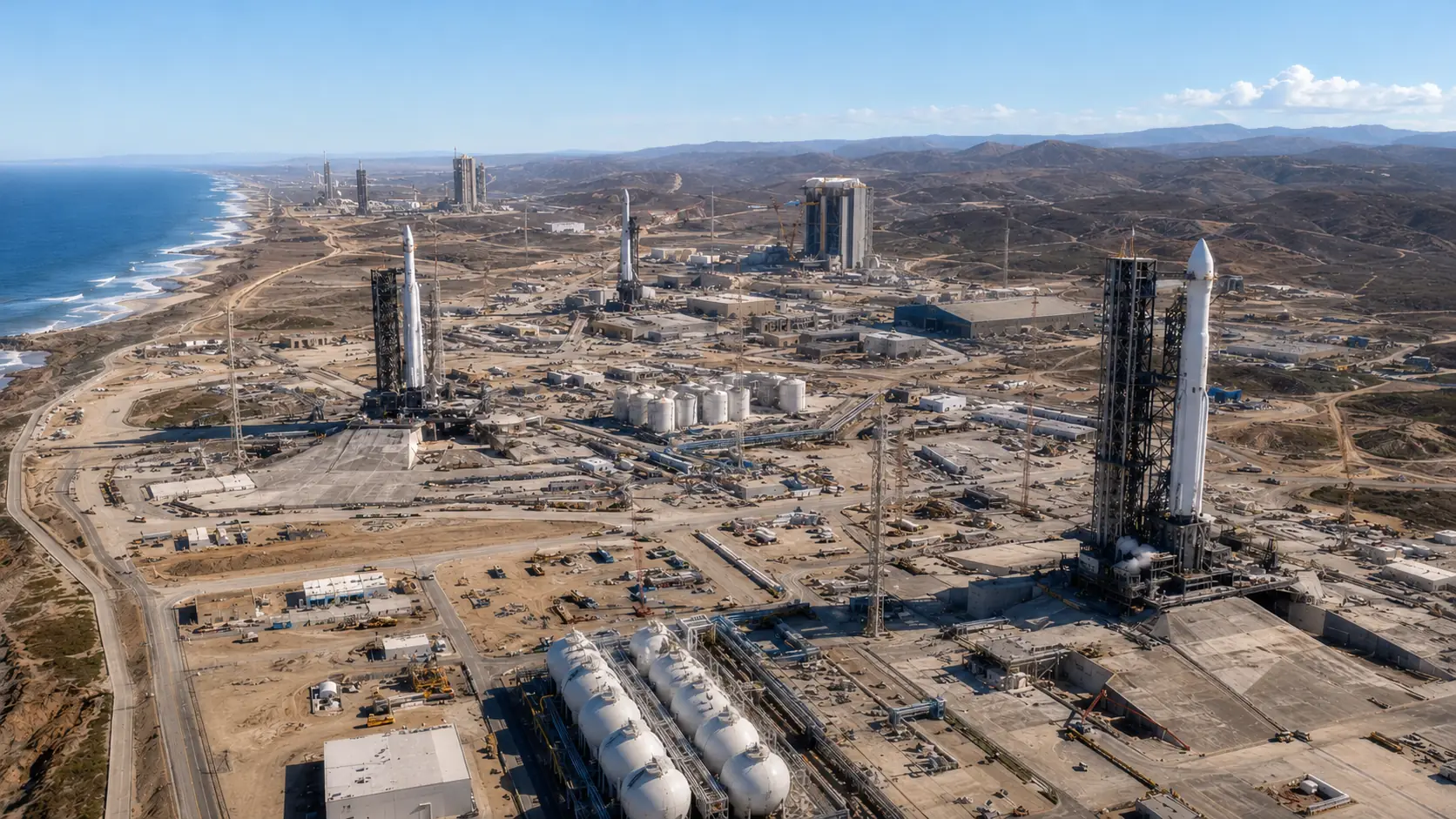
Avelor Astronautics has spent the last three years telling investors, regulators and the public a straightforward story: reusable launch vehicles are getting cheaper, orbital demand is rising, and the company intends to be ready when that demand arrives. The numbers support part of that story. They also appear to support more than that.
A review by The Halden Ledger of publicly available construction permits, supplier disclosures, procurement records, land-use filings and hiring notices shows Avelor expanding several parts of its launch and industrial network at once, often at a pace that exceeds what the company has publicly tied to its current commercial schedule.
None of the projects examined by the Ledger is inexplicable on its own. Taken together, they raise a harder question: what is Avelor building the capacity to do?
More pads than the schedule requires
At Horizon Point, Avelor’s sprawling launch and manufacturing complex on the California coast, the most visible expansion is happening in parallel rather than sequentially. New pad infrastructure is under construction while existing facilities are being upgraded. Additional propellant storage has been permitted. Recovery and servicing zones are expanding. The company is also adding integration space and ground-support equipment designed to reduce the time between flights.
Avelor has said repeatedly that higher launch cadence is central to its business model, and that explanation is credible. What remains less clear is why the company appears to be building multiple layers of excess capacity at the same time.
Avelor’s current public launch projections do not require every facility now under construction to operate near full utilization. Even under aggressive growth assumptions, some of the new infrastructure would remain lightly used for years.
Asked about that gap, an Avelor spokesperson said the company is “building ahead of demand in a market where waiting for demand to become obvious guarantees arriving too late.” The answer is consistent with founder Adrian Serrin’s long-standing approach to capital spending. It is also broad enough to explain almost anything.
Suppliers are seeing the same signal
The pattern extends beyond Avelor’s own property. Several suppliers have announced capacity increases tied directly or indirectly to Avelor programs, including propulsion components, cryogenic systems, composite structures, avionics and automated inspection equipment.
Some of those companies describe the expansion as support for “anticipated future volume.” Others cite multi-year purchase commitments without identifying the full program behind them. The Ledger identified multiple cases in which suppliers appear to be scaling for production volumes materially above Avelor’s present launch requirements.
That does not prove the company expects to use all of the capacity immediately, but it does suggest the growth is coordinated.
What the Ledger found
- Launch and recovery infrastructure expanding in parallel at Horizon Point.
- Propellant storage capacity increasing faster than publicly announced flight demand.
- Supplier investments tied to unusually large long-term production commitments.
- More modular orbital hardware entering integration than Avelor has publicly associated with a single destination.
- Hiring growth in operations, logistics and systems integration rather than only vehicle engineering.
Not just rockets
The strongest indicator may be the kind of infrastructure Avelor is adding. Rocket companies traditionally talk about vehicles: engines, stages, payload capacity and launch price. Avelor increasingly talks about systems.
The company is expanding orbital logistics, tanker architecture, cargo handling and support equipment that can serve multiple destinations. Some designs are publicly associated with lunar operations. Others have been described as Mars-enabling infrastructure.
A modular tanker does not depend on one destination, and neither does a cargo platform or a high-cadence launch complex. The same infrastructure can support the Moon, Mars, an orbital station or something else entirely. That flexibility is commercially sensible, but it also makes Avelor’s real planning horizon difficult to infer from its public statements.
Themelion changes the equation
Avelor’s lunar operations provide the clearest public justification for some of the expansion. Every additional resident, excavator, pressure module and industrial system at Themelion creates transportation demand. Unlike a communications satellite, a settlement does not finish launching when it reaches orbit. It continues consuming mass.
Food, electronics, replacement parts, specialized machinery and construction equipment must keep moving. If Themelion grows quickly enough, Avelor will need launch capacity that looks excessive by today’s standards.
Even generous lunar-growth assumptions, however, do not cleanly account for every project in the pipeline. The company appears to be preparing not merely for more missions, but for a different operating model: one in which launches are routine, vehicles turn around quickly, cargo moves continuously and orbital infrastructure functions more like a transportation network than a collection of individual missions.
The Serrin factor
Investors have historically rewarded Adrian Serrin for spending before conventional models justified it. Avelor’s reusable launch architecture looked overbuilt before its cadence increased. Themelion looked premature before permanent crews arrived. Several technologies the company funded years before they had obvious markets now sit at the center of its business.
That history gives Serrin unusual latitude and makes scrutiny harder. When a chief executive has been right about timing often enough, “he is early again” becomes an explanation that can survive almost any amount of capital spending.
In an interview with the Ledger last month, Serrin described infrastructure as something that must exist before the need for it becomes urgent. He declined to discuss specific internal demand forecasts.
What the company says
In written responses to the Ledger, Avelor rejected the suggestion that its expansion reflects any undisclosed program or near-term mission architecture. The company said Horizon Point is being built around “long-duration commercial growth, increased lunar activity, emerging orbital markets and the expectation that launch demand will continue to diversify.”
Avelor also noted that large aerospace infrastructure has long construction lead times and cannot be added instantly when customers appear. Both points are reasonable. They still leave an unusually large margin between what the company says it expects and what it appears physically capable of supporting.
Capacity is a kind of statement
Companies reveal themselves in more ways than press releases. Hiring patterns, purchase commitments, land use and physical infrastructure all constrain what a company can do later, and Avelor is making those commitments at a scale that deserves attention now.
Its public explanation is that the future of spaceflight will require scale. The infrastructure rising at Horizon Point suggests the company believes that future is close enough to justify paying for it today.
The open question is whether Avelor simply expects the market to move faster than everyone else, or whether Adrian Serrin is planning around assumptions he has not yet shared.
The Halden Ledger contacted Avelor Astronautics for comment on each category of infrastructure described in this report. The company responded in writing and declined requests to provide internal utilization forecasts.