Evelyn Grant Says Washington Is Built to Prevent Action. Her Coalition Wants to Change That.
The rising lawmaker has assembled an unusual coalition around a simple argument: a government designed to restrain power may have become too good at restraining itself.

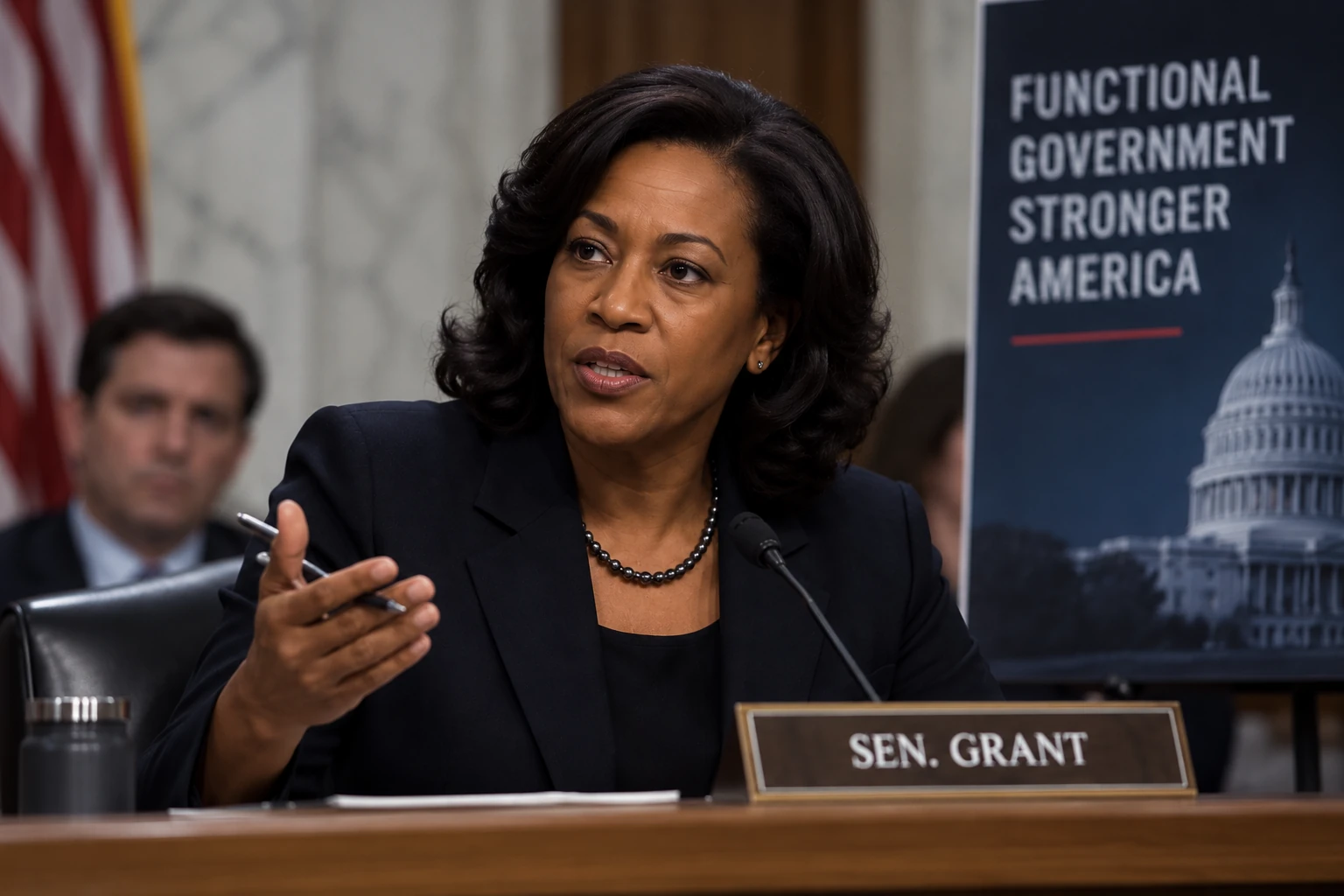
Evelyn Grant has spent much of the past six months making an argument about Washington that is easier to recognize than to solve: the rules designed to keep government from moving too quickly can also keep it from moving at all.
That argument has given Grant, a relatively young member of Congress with little national profile a year ago, an unusual collection of allies. Governors frustrated by federal delays have joined lawmakers worried about shutdowns, former agency officials who spent years navigating procurement rules and business groups that want infrastructure decisions made faster.
Grant calls it the Continuity Coalition. Its members disagree about what government should do. They have found more common ground around the question of whether it can still do it.
Some want faster infrastructure permitting. Others are focused on federal procurement, emergency response or the recurring threat of government shutdowns. Their common argument is that the federal government has accumulated so many points at which action can be delayed that delay itself has become a form of policy.
“The Constitution was designed to make power difficult to abuse,” Grant said during a forum in Denver last week. “It was not designed to make basic government functions impossible to perform.”
Her proposed solution would remove some barriers. It could also shift power toward the presidency.
A government that keeps operating
The coalition's proposal is not a constitutional amendment or sweeping reorganization. Most of its provisions are narrower.
Federal agencies would receive greater authority to move money between previously approved programs during declared emergencies. Certain infrastructure projects could use accelerated reviews when existing facilities are at risk of failure. Procurement rules would be relaxed for agencies responding to disruptions involving energy, transportation or communications.
The provision attracting the most attention would allow some government operations to continue temporarily during a lapse in congressional appropriations.
Under the proposal, a president could activate a temporary continuity authority after a defined period without appropriations or following a qualifying national emergency. Agencies designated as essential could continue operating at previously authorized funding levels, while the executive branch could redirect a limited portion of existing appropriations toward critical services.
Congress could terminate the authority, but it would have to agree to do so.
Under the current system, Congress generally authorizes spending and the executive carries it out. Grant's proposal would preserve Congress's ability to establish limits while changing what happens when Congress cannot reach a decision. Instead of requiring congressional agreement before some actions could continue, the government could continue acting until Congress agreed that it should stop.
At a glance: Grant's proposal
- Allow designated federal operations to continue temporarily during prolonged funding lapses.
- Give agencies limited authority to redirect previously appropriated money during qualifying emergencies.
- Accelerate some procurement and infrastructure decisions.
- Preserve judicial review of executive actions.
- Allow Congress to terminate the temporary authority through legislation.
The disagreement is partly about emergency power. It is also about something less visible: what happens when nobody makes a decision.
The case for acting
Washington has supplied Grant with plenty of examples.
Federal agencies have spent much of the year preparing for another possible funding lapse, while state governments have complained about delays in infrastructure grants and disaster reimbursements. Manufacturers seeking federal support for domestic production have described procurement timelines measured in years, and energy developers routinely identify permitting uncertainty as an obstacle to new projects.
Grant's proposal would not eliminate all of those problems. Her coalition argues they share a structural feature: multiple institutions can prevent something from happening, while few have the authority to make it happen.
“We've built a system where everybody has a brake pedal,” said Marcus Bell, a former deputy transportation secretary advising the coalition. “The question is whether anybody still has a steering wheel.”
The coalition's diagnosis has proved easier to sell than its remedy. Even some of Grant's allies agree that federal decision-making has become cumbersome while questioning whether the answer is to make presidential action easier.
Professor Helen Armitage, who teaches constitutional law at Georgetown University, said temporary emergency authorities have a tendency to survive the circumstances used to justify them.
“The strongest argument for these powers is always the situation immediately in front of you,” Armitage said. “The constitutional question is what authority you have created for the situation that comes afterward.”
Grant's proposal includes expiration dates for individual declarations and allows federal courts to review actions taken under them. The coalition also added reporting requirements after early drafts drew criticism from civil-liberties groups.
“The president doesn't get to write laws,” Grant said. “The courts don't disappear. Congress doesn't disappear. What disappears is the assumption that failure to reach an agreement must automatically produce failure of the government.”
The problem of the next president
Not everyone in Grant's coalition supports the continuity provision. Sen. Thomas Vale, an independent who has endorsed the coalition's procurement and infrastructure proposals, said he would vote against the emergency authority in its current form.
“You never write an executive-power statute for the president you trust,” Vale said. “You write it for the president you don't.”
Powers created for one crisis can remain available when political circumstances change. Authorities established after terrorist attacks have been used in investigations unrelated to terrorism, and emergency declarations have been used by presidents of both parties for purposes Congress did not necessarily anticipate when the underlying statutes were written.
Grant says that history is an argument for clearly defining emergency powers rather than pretending presidents will not use them. Her critics say it is an argument for not expanding them.
Grant's growing national profile has also led to speculation about higher office, which she has repeatedly dismissed as premature. Asked whether she would support the same proposal if a political opponent occupied the White House, Grant did not hesitate.
“Yes.”
She paused.
“If your system only works when the right person is in charge, you don't have a system.”
When the emergency ends
The coalition expects to release revised legislative language before the end of the year. Several provisions could move independently, and congressional leaders have given no indication that the full package will receive a vote.
The continuity authority faces the greatest resistance. Its current draft limits an initial declaration to sixty days. A president seeking to continue it would have to issue a new justification, and Congress could pass legislation terminating the authority at any point. Courts could review whether the conditions required by the statute had been met.
Grant's proposal is built around the premise that there will be moments when Congress is too divided or too slow to respond. During those moments, it would allow the executive branch to act without waiting for Congress to agree.
Congress would retain the power to stop it.
Doing so would require agreement between the same institutions whose inability to agree is the reason Grant says the authority is necessary in the first place.