The Mussels That Keep Moving West
Quagga mussels have already transformed reservoirs across the Southwest. Water managers are spending more time and money trying to keep them out of the systems they have not reached.

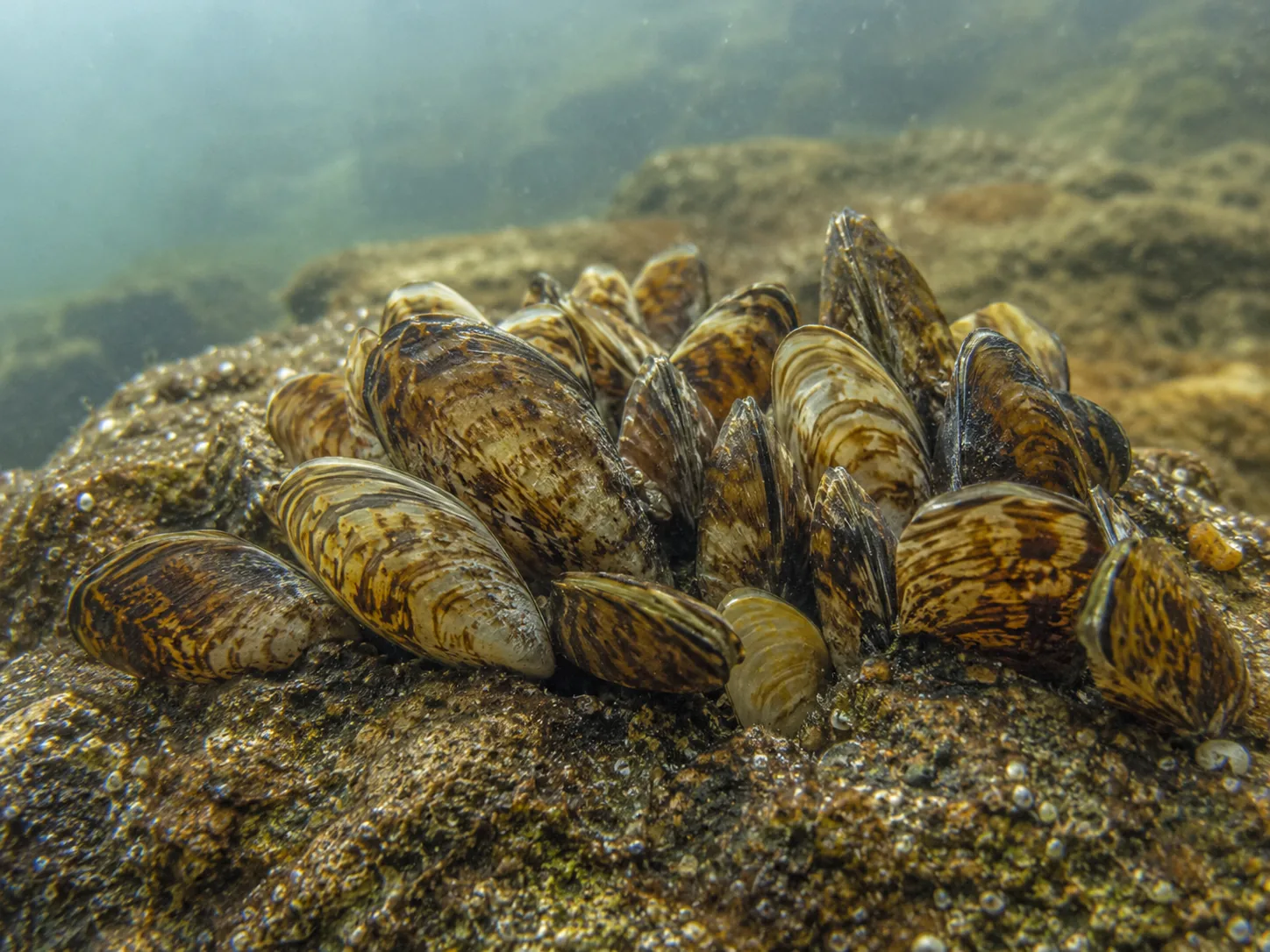
A quagga mussel is easy to underestimate when it is sitting by itself.
The shell is small enough to fit comfortably in a palm, striped in muted browns and creams, with none of the drama usually associated with an invasive species. The trouble begins when there are thousands of them, then millions, attached to anything that stays underwater long enough.
Intake pipes narrow. Screens collect shells. Pumps require more attention. Boats carry hitchhikers to the next reservoir. Underwater structures that were designed to sit quietly for decades acquire a living coat that has to be inspected, cleaned or worked around.
Across much of the western United States, water managers have been dealing with that reality for years. The larger concern is where the mussels go next.
A small animal with an infrastructure problem
Quagga mussels are freshwater mollusks native to parts of eastern Europe. They appeared in North America in the late 1980s and eventually moved into western waters, where they were detected in Lake Mead in 2007. They have since established themselves in parts of the Colorado River system and in reservoirs in Arizona and California.
Much of the spread comes down to how easily they travel with people.
Adult mussels can attach themselves to boats, trailers and equipment. Their microscopic larvae, called veligers, can remain in small amounts of water trapped inside bilges, live wells, motors and ballast systems. A boat does not have to leave a reservoir visibly covered in mussels to carry them somewhere else.
Once established, they are exceptionally difficult to remove from an open body of water. Managers instead spend much of their effort slowing the spread and protecting the infrastructure that has to keep operating in infested systems.
That distinction explains the inspection stations that have become familiar to western boaters. Staff check hulls and compartments, drain standing water and, when necessary, decontaminate equipment before it travels to another lake.
The inspections can look disproportionate to an animal smaller than a thumbnail, until the same animal is considered inside a municipal intake or pumping plant.
Western water has a lot of plumbing
Reservoirs in the West are not simply lakes with dams at one end. Many are working pieces of large water-delivery networks.
Water leaves them through intakes, tunnels, pumping plants, canals and pipelines. It may be used for drinking water, irrigation, hydropower or industrial supply hundreds of miles from where it was stored.
Quagga mussels attach readily to hard surfaces inside those systems. Colonies can form on intake structures, screens, gates, pumps and pipes. Even when an infestation does not stop the flow of water, it can add inspection, cleaning and maintenance to equipment that already operates on tight schedules.
Some control methods work well inside pipes and other confined infrastructure. Operators can use mechanical cleaning, drying, heat or carefully managed chemical treatments depending on the system. Open reservoirs are much harder.
Agencies therefore spend money on existing infestations while maintaining inspection and prevention programs for waters that remain clear.
The boat that looks clean
Prevention is frustrating because the riskiest boat at an inspection station may look completely ordinary.
A visible adult mussel is simple enough to find. Residual water is harder. A few ounces trapped in a compartment can contain larvae too small to see without magnification.
The standard advice is simple: clean, drain and dry anything that has been in the water. In practice, modern recreational boats contain enough compartments, pumps and plumbing to make the last part difficult.
That problem has attracted federal attention. In 2026, the Bureau of Reclamation launched a prize challenge seeking better ways to kill, exclude or inactivate aquatic invasive species carried in watercraft ballast systems.
The challenge reflects a gap that water managers know well. Inspection programs are effective only if inspectors can reach the places where water remains.
Inspectors are often more interested in the water they cannot immediately see than in the hull itself.
What changes underwater
The mussels do more than clog equipment.
Quaggas are filter feeders. Large colonies pull microscopic plants and animals from the water, changing how food moves through a reservoir. Clearer water can look like an improvement from the shoreline while reflecting a major shift below the surface.
Those changes ripple through ecosystems differently from one reservoir to another. Fish populations, nutrient cycles and the growth of aquatic plants can all respond as the base of the food web changes.
That is one reason scientists are cautious about promising a single ecological outcome. A mussel invasion does not produce the same reservoir everywhere, and the effects can take years to become obvious.
The effects on infrastructure are easier to document because managers can see and measure the buildup directly.
At heavily infested waters, mussels can cover submerged equipment and recreational surfaces. Dead shells accumulate along shorelines. Boat motors and cooling systems need more attention. Facilities built before the invasion arrived have to be operated in an environment their designers never expected.
Why eradication is so difficult
There is no simple treatment plan for a large reservoir once quagga mussels are established.
A reservoir may hold billions of gallons of water, connect to downstream systems and support fish, wildlife, recreation and drinking-water supplies at the same time. A treatment strong enough to eliminate mussels across that entire environment would also have to avoid unacceptable damage to everything else using it.
No broadly practical method currently exists for eradicating an established quagga population from a large open reservoir.
Much of the work is repetitive: inspecting boats, decontaminating equipment, monitoring for larvae, protecting pipes and testing control methods through another boating season.
Prevention programs rarely produce dramatic evidence of success. A reservoir remains uninfested, an inspection finds nothing and another monitoring sample comes back negative. Water managers would prefer to keep collecting results like those.
The reservoirs still outside the line
The western spread of quagga and zebra mussels is uneven. Some large systems are infested; others remain free of them despite years of exposure risk.
Geography helps, but human behavior matters. Trailering a boat over a mountain pass can move an aquatic species between watersheds faster than any river could.
Highway inspection stations and marina wash facilities have consequently become part of the region's invasive-species defenses, even when they look more like ordinary maintenance stops than environmental protection.
No inspection network catches everything. Boats move, equipment changes hands and larvae can travel in very small amounts of water.
But every reservoir the mussels have not reached is still worth protecting. Once they arrive, the problem changes from prevention to permanent management.
The quagga mussel does not need to move quickly. It only needs one wet compartment, one overlooked piece of equipment or one trip to the next lake.
For western water managers, keeping it from making that trip has become part of the job.