Can Machines Build the Machines?
A new generation of automated industrial systems is being designed to do more than repeat a task. The harder goal is to let one production system help create the next.

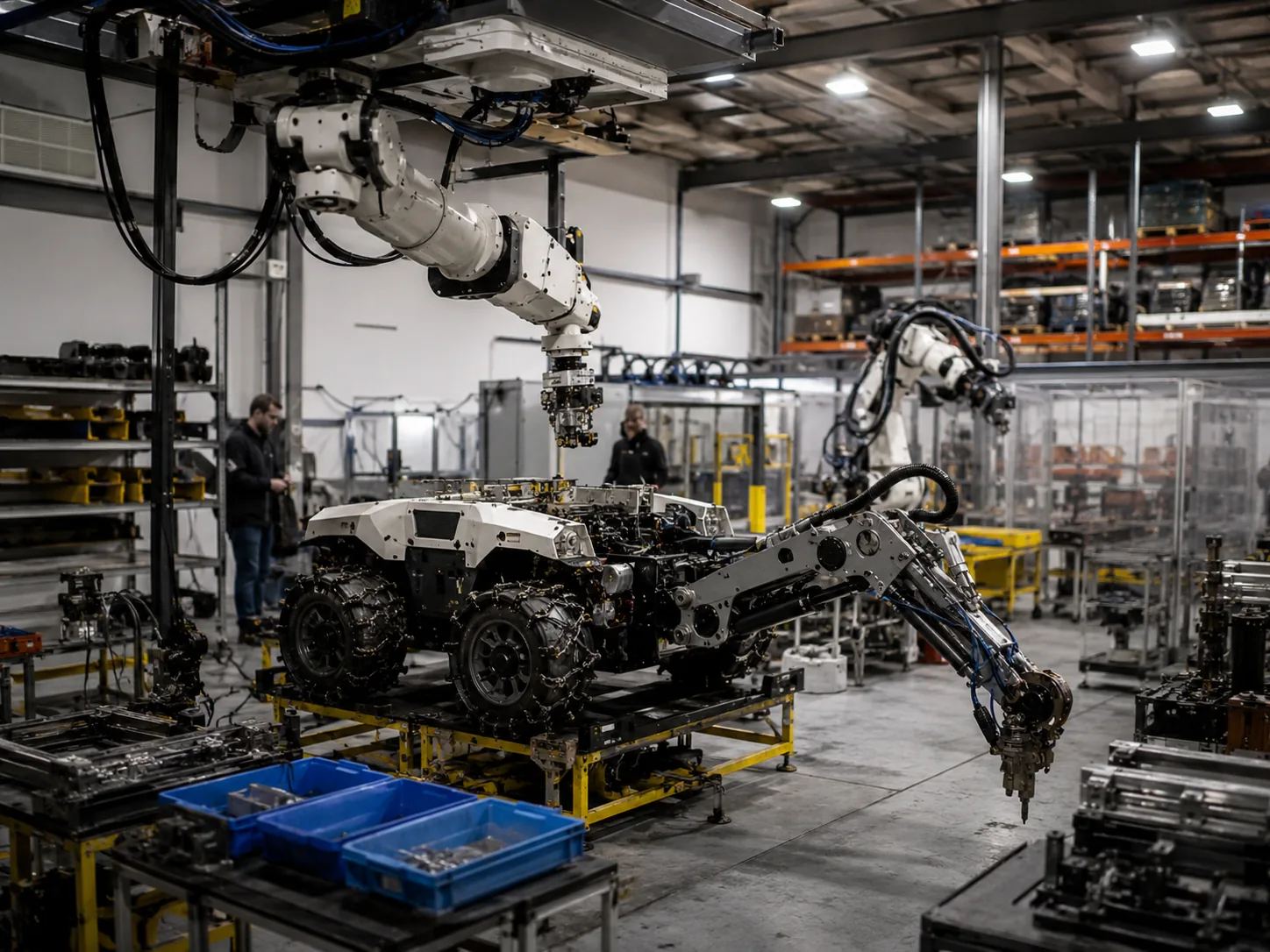
The machine on the assembly can't quite build itself from scratch.
The system can inspect parts, move components between stations, perform several assembly steps, test the result and route a failed unit back for rework. Some of the equipment it helps assemble can later be used elsewhere in the same production network. But the raw materials arrive from outside suppliers, the tooling was designed by people, and technicians still intervene whenever the process reaches the edge of what the software understands.
Even with those limits, the project points toward a manufacturing problem that has occupied robotics researchers for years: how much of an industrial system can be built and expanded by the industrial system itself?
The question has become more practical as companies including Nyvolis Technologies and Avelor Astronautics invest in automated construction, remote maintenance and equipment designed for places where adding another shift of workers is difficult or expensive.
On Earth, that can mean a remote mine or an automated warehouse. Beyond Earth, the economics become harder to ignore.
The bottleneck is not the robot
Industrial robots are already common. They weld vehicle frames, move pallets, inspect circuit boards and perform repetitive operations with speed and consistency that human workers would struggle to match.
Those machines are usually surrounded by an enormous amount of human-built support. Someone installs the line, calibrates the tooling, replaces worn components, updates the software, clears jams, manages inventory and decides what the factory should make next.
Removing a worker from one station does not remove that surrounding system.
The newer research is aimed at the surrounding system.
Engineers are combining automated inspection, modular tooling, machine vision, mobile robotics and software that can reassign work when equipment fails. The ambition is not a factory that operates without people. It is a factory that needs fewer people standing next to every machine in order to keep functioning.
That difference is especially important for off-world industry. A broken actuator on Earth can be replaced from a warehouse. A broken actuator on the Moon may wait for the next cargo flight unless somebody planned for the failure months earlier.
Anika Rao starts with failure
Anika Rao is one of the engineers working on that problem.
Rao's background is in automated manufacturing and systems integration, the part of engineering where a machine that works perfectly by itself still counts as a failure if it cannot survive the factory around it.
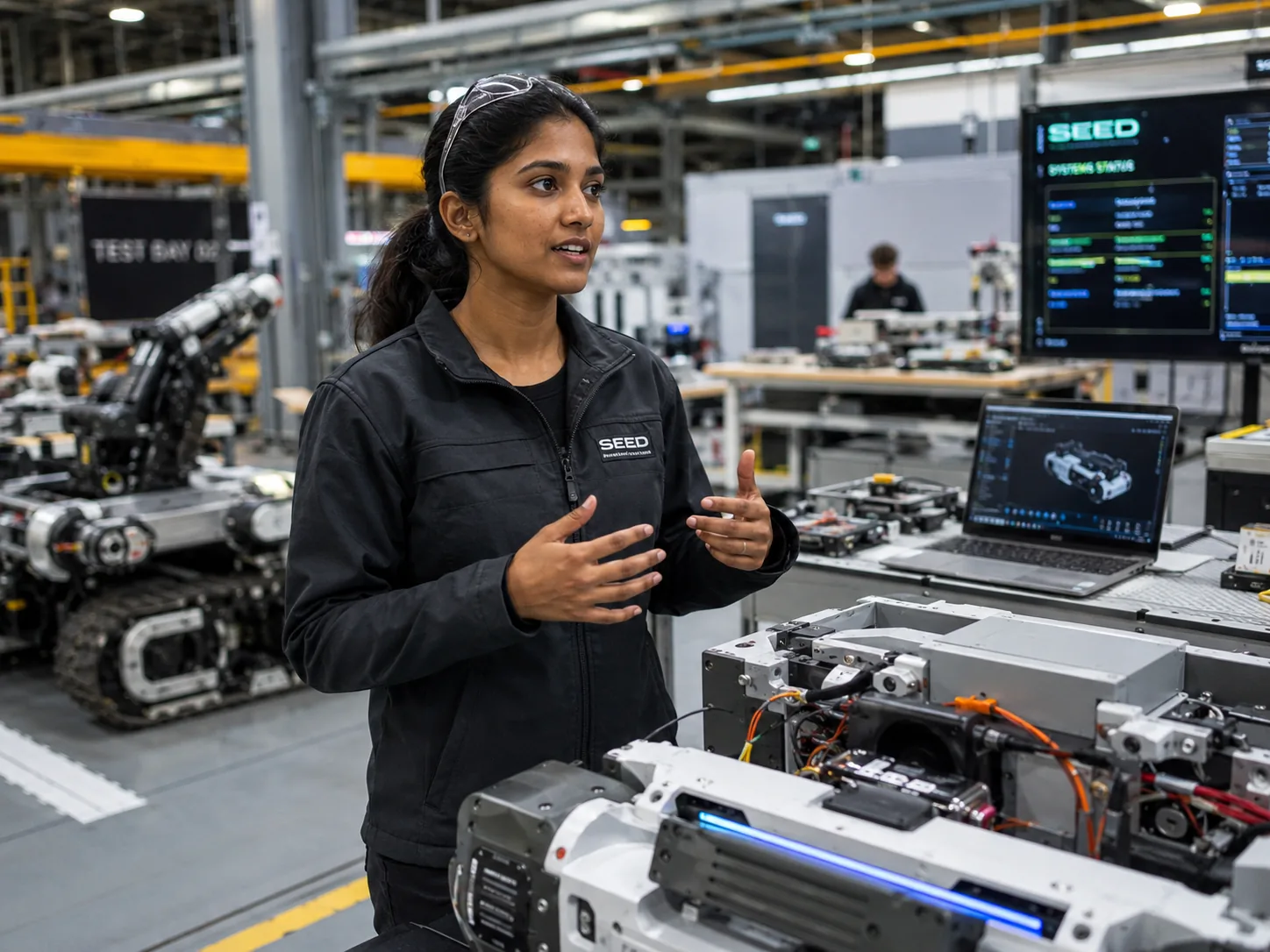
During a recent demonstration, Rao spent more time talking about what the system could not do than what it could.
One manipulator could exchange its own end tool, but it could not repair the tool. A mobile platform could deliver parts between stations, but only within a mapped work area. The inspection system could identify several classes of defect, though unfamiliar failures still went to a human technician.
“The impressive demo is the machine doing the task,” Rao said. “The useful demo is what happens when the task goes wrong.”
That is a less spectacular benchmark, but it is the one that determines whether automation scales.
Building capacity, not copies
The phrase “self-replicating factory” appears frequently in discussions of advanced automation. It is also a poor description of what current systems can do.
A modern factory depends on too many specialized inputs for literal self-replication to be a useful near-term target. Semiconductors, bearings, sensors, lubricants, precision optics and high-performance materials all come from supply chains that stretch far beyond a single building.
Researchers are instead concentrating on a narrower question: can an automated system increase some of its own useful capacity?
A robotic work cell might assemble additional mobile platforms from delivered parts. Those platforms could move material, inspect equipment or prepare new work areas. A fabrication system might produce brackets, housings or structural pieces used to install another production line. Automated excavation equipment could prepare a site where more equipment will later operate.
None of those machines has reproduced itself. The industrial network has still grown.
That is the part engineers care about.
Why the Moon changes the math
The economics are straightforward even when the engineering is not.
Every machine delivered to a lunar settlement occupies launch capacity. So does every replacement part, every repair tool and every additional piece of construction equipment. A system capable of producing even a modest fraction of those items locally can reduce the amount of mass that has to be delivered later.
The first targets are likely to be simple.
Structural members do not require semiconductor fabrication. Regolith handling does not require a factory capable of producing precision optics. Basic shielding, site preparation, storage structures and some classes of mechanical replacement parts can be made with much less industrial depth than a complete spacecraft.
The more material that can be sourced locally, the more useful the automation becomes.
That is one reason lunar infrastructure projects such as Themelion matter to robotics researchers. A permanent site creates repeated maintenance and construction work in a place where labor, spare parts and transportation are unusually expensive.
It gives automation a problem worth solving.
The parts still have to come from somewhere
The supply-chain problem does not disappear because a robot moves the parts.
A factory that can assemble ten machines from imported components still depends on imported components. If one motor controller comes from Taiwan, a bearing from Germany and a sensor package from California, the production line is only as autonomous as its least replaceable part.
A useful measure of autonomy is therefore not simply how many tasks can run without a worker standing nearby. It is how much of the production system can keep operating when a component fails, a shipment is late or a machine encounters something outside its normal routine.
That is where modularity becomes important. Standardized motors, common fasteners, interchangeable controllers and machines designed around replaceable subassemblies can make a limited inventory support more equipment.
The result looks less elegant than a machine building an identical copy of itself. It is also much closer to how real factories expand.
A factory that can help build a factory
The most interesting threshold may arrive long before anything resembling full industrial independence.
Imagine a remote site with one excavation unit, one materials processor and several general-purpose mobile robots. If that equipment can prepare foundations, move feedstock, fabricate simple structural components and install part of a second production area, the site has gained something important: new capacity no longer requires every kilogram of supporting infrastructure to arrive finished.
Humans would still design the expansion. Imported electronics and precision components would still be required. Technicians would still solve the failures the machines could not.
But the ratio changes.
One shipment supports more construction. One technician supervises more machines. One production line helps install another.
For a warehouse in Nevada, that may improve margins. For a lunar base, it can determine whether growth is practical at all.
The prototype question
There is a familiar mistake in emerging technology: treating a successful demonstration as evidence that the difficult part is finished.
A prototype proves that a machine can work. A factory proves that somebody believes it matters.
The automated systems now being tested remain heavily dependent on conventional supply chains, human supervision and controlled environments. They are not autonomous industrial ecosystems, and the engineers closest to them generally do not describe them that way.
What has changed is the direction of the work.
Automation is moving outward from individual tasks toward the infrastructure around those tasks: inspection, maintenance, logistics, fabrication and expansion.
Rao put it more simply.
“If every new machine requires another team of people standing beside it,” she said, “you have automated a machine. You have not automated growth.”
The machines on the floor are not there yet.
They are beginning to show what the next step looks like.